


LAET Artists Exhibit at the Sarabande Foundation
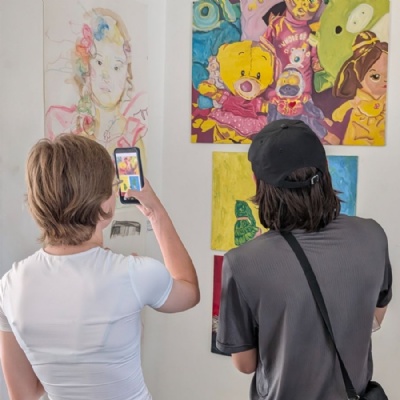
At the end of the summer term, LAET A-Level Art students again had the opportunity to display their artwork at the Sarabande Foundation gallery on Tottenham High Road, right on our doorstep.
Established by the late fashion designer Lee Alexander McQueen, the Sarabande Foundation supports emerging creatives through subsidised studio spaces, scholarships, and exhibitions. Operating out of restored Grade II* listed Queen Anne townhouses in N17, the foundation champions bold, original work. Having a private view in a professional contemporary gallery space dedicated to new talent gave our students an authentic platform to share their work with the public.


Celebrating Our Student Artists
The private view brought together students, staff, governors, and families, who filled the gallery to see months of hard work and experimentation come to life.
This year’s exhibition featured eleven student artists: Jiaqi, Ezekiel, Alexia, Chidera, Amelia, Esme, Jakub, Hanzo, Milda, Haneen, and Krysiah. Adding to the evening, three LAET alumni from the 2024 cohort, Levent, Ernest, and Khalid, made an appearance to support the current students in the very same gallery where their own work was displayed two years ago.


During the evening, we spoke with four of the exhibiting artists, Alexia, Haneen, Krysiah, and Jakub, about the ideas and processes behind their work.
Common Threads
Across all four conversations, a clear shared focus emerged around personal identity, memory, and the experience of inhabiting two worlds at once.


Jakub, Haneen, and Alexia each used their work to look at family roots and major moves. Born in London to a Polish family, Jakub focused on what it feels like to grow up between two cultures without belonging fully to either. Haneen traced her moves from Egypt to Saudi Arabia and finally to the UK, creating work that captures a journey still in progress. Meanwhile, Alexia turned to her Romanian heritage and early family memories, translating them into an unexpected, sensory experience for visitors.

While Jakub, Haneen, and Alexia examined geography and cultural roots, Krysiah looked inward at psychological and creative duality. Her work bridged two sides of her artistic life that she had long kept separate: her formal school art education and her personal love of manga and anime, alongside a visual exploration of a childhood experience of nearly drowning.
Contrasting Techniques and Experimentation
Although their themes overlapped, the materials and methods these students chose were completely distinct. Jakub paired fluid watercolour with deliberate, unforgiving ink to reflect how his dual identities overlap while remaining separate. For his second project, Origins, he shifted to sculpture, assembling twenty to twenty-five broken electronic devices into a cube to highlight repair culture and the value in discarded technology.

Haneen worked across fabric and wallpaper, deliberately leaving a tent structure incomplete so it resembled a half-open door, symbolising that her life experiences are far from finished. In her second piece, she threw ink onto paper through repeated trials, building vibrant colours and physical depth to draw attention to overlooked mushrooms pushing through cracks in the pavement.


Alexia combined photography and installation to capture traces of passing time, using intentionally blurred photography to evoke fleeting memories alongside hanging red strings shaped by the sound waves of Romanian cultural dances and family conversations. Meanwhile, Krysiah adapted the visual structure of manga into a series of panels, allowing her personal drawing style and formal training to sit together on one canvas while examining innate and learned fears.
Documenting the 808 High Road Redevelopment
Our partnership with Sarabande also extended beyond the exhibition to our Year 12 students, who were invited to document the restoration of the foundation’s new building at 808 High Road. Working alongside fellow Tottenham Hotspur campus neighbours F3 Architects, students filmed how the restoration was brought together and explored the historical background of the local area.


As part of their research, the group carried out project work at Bruce Castle to uncover the site's heritage, while liaising directly with F3 architect Akshata Hatle to learn about the architectural elements and design decisions behind the building's transformation.
Looking Ahead
As these students move on from LAET, their plans span creative, technical, and scientific disciplines, though every one of them intends to keep art in their lives.
Krysiah is exploring degrees and degree apprenticeships in game design, technology, or urban development. Haneen plans to study the mathematical side of architecture, with hopes of pursuing interior design afterwards so she can bring art back into her career. Alexia is heading to university to study veterinary medicine, and Jakub plans to continue using art as a tool for self-discovery, with both committed to creating in their own time.
Thank You
A huge thank you goes to our student artists for the craft they put into every piece on display, and to the Sarabande Foundation for hosting our students once again.
Special thanks also go to Ms Honess and Ms Carter for their guidance and support throughout our students' LAET art journeys, and to every family member, friend, student, staff member, governor, and alumnus who came along to celebrate their work.
To hear more directly from the artists, open the dropdown menus below to read the full interviews with Alexia, Haneen, Krysiah, and Jakub.
Alexia


Hi, I’m Alexia, and this piece is based on my heritage and culture. The little red elements hanging in the space represent sounds from cultural dances and conversations in Romanian, inspired by my family and my childhood memories. My goal was simply to share my culture with the world in a way people wouldn’t expect.
The photographs were created around the theme of "traces," focusing heavily on movement. I wanted to capture a moment in time as it was actively happening, which is why I went for a blurry, indistinct look where you cannot quite see everything clearly. I wanted viewers to look at my work and reflect on how moments pass by in life; you never get to grasp them fully, and they eventually remain only as passing memories.


The soundwaves act as templates and markers for those red string pieces. There were many recordings and elements to choose from, so I narrowed them down to the most meaningful ones specifically sounds you wouldn't normally expect to associate with a traditional visual piece or dance.
Now that I have finished at LAET, I am going to university to study veterinary medicine. Even though I am taking a scientific path, I still plan to keep creating art a lot in my own time.
Haneen


Hi, I’m Haneen, and this is my final piece. Originally, it was supposed to be a full tent representing the different stages of my life moving between countries. I lived in Egypt for six years, then Saudi Arabia for six years, and then I came to the UK. As I worked on it, I realised those moves do not represent my entire life’s journey, so a completed tent wouldn’t quite make sense. Instead, I decided to create something like a half-open door showing that the full tent isn't actually there yet, and that there is still so much more to life and far more experiences to come. For this piece, I worked with techniques on both fabric and wallpaper.
My other piece explores overlooked plants, focusing specifically on mushrooms. We usually only see them sitting on the ground, so I wanted to show that there is far more happening beneath the surface. I represented them emerging toward us through cracks in the pavement, using very vibrant colours to draw attention to them and encourage people to take a closer look. I also built depth into the piece to reflect that there is much more going on than just what we see above ground.
Finding this direction required a lot of experimentation. Most of the time, I was throwing ink onto paper and doing loads of trials until the final look came together naturally.

Now that I have finished at LAET, I am planning to study architecture. Since I am focusing more on the mathematical side of architecture, fine art won’t play a direct role at first, though I am considering studying interior design afterwards so I can bring art back into my work. Either way, art will always remain a hobby for me, something I continue doing in my free time.
Krysiah


Hi, I’m Krysiah. This piece was inspired by horror and horror-related themes. Since that was my general focus, I eventually started exploring what actually makes people feel scared. I looked into different types of fears, including innate fears and learned fears. This piece was specifically inspired by the fear of drowning. Once I researched the different fears people experience, I chose drowning because it felt like the easiest one for me to bring to life. I say easy because I have had a near-drowning experience when I was younger. I was fine in the end, but the feeling stayed with me. I wanted to express that feeling in a visual way and see if it connected with anyone else.

On the other side, there is a series of panels. This work was inspired by my love of manga. I am very nerdy when it comes to anime and manga, and I have always drawn in that style at home. The story behind these panels shows the two worlds I have lived in. One is my formal art education. The other is the art I make at home, which is heavily influenced by manga.
For a long time, I felt as if I could not combine those two worlds. Because of that conflict, I often felt as if I was not a genuine artist. I kept my school work and my personal work separate, and that made it hard for me to form the deeper connections I wanted in my art. I struggled to understand how to go deeper with a piece, and I did not always feel inspired by formal artists. My love for art started with the media I consumed, so separating my influences from my schoolwork felt frustrating.
Eventually, I managed to overlap the two. At the end of the day, both sides are still me. There is no reason for me to hide either one, and there is no reason I cannot use what I have learned from both to create one smooth experience. The best way to show that was through a series of panels. I took inspiration from manga, which uses panels to tell a story. My panels are different in style, but the idea came from there.
Now that I have finished at LAET, I plan to study game design at degree level. I am also looking into degree apprenticeships. I am interested in areas that are either technology-based or creative. I am exploring options in urban development, technology-related fields and creative sectors.
Jakub


Hi, I’m Jakub, and my art this year explored two main themes: diaspora and origins. For my diaspora project, I worked mainly with watercolour and ink. I used these mediums to depict myself and my close family. This comes from the fact that I was born in London, but my nationality is Polish. I often feel caught between the two. I do not feel entirely part of either culture, so I wanted to express that tension visually. I wanted to show a sense of connection to both, while also showing the feeling of living between two separate worlds.
That is why I chose watercolour and ink. Watercolours blend, mix and connect. Ink is more defined, more separate and more deliberate. I wanted the contrast between them to reflect how these identities sit within me. They overlap in some ways, but they remain distinct.
The biggest challenge in this project was the refinement process. It is repetitive and can feel tedious. You have to revisit ideas, rework them, and sometimes find meaning in places you did not expect. Ink is especially unforgiving. I spilt some here, and you can still see the mark. But overall, it became a meaningful path of discovery. When I look back at all the iterations, it was a long journey, but one I am proud of. It led to the final pieces you see here.


My second project, Origins, was an eight-week piece. I wanted it to be something I felt genuinely connected to, and technology has always been a big interest of mine. I am especially drawn to older or discarded tech that people throw away. I still see value in it. I collected around twenty to twenty-five broken devices, which, with the right equipment, could technically be repaired. But because manufacturers do not provide parts, and because processes like micro soldering are so difficult, repairing them is not really viable.
So I combined these devices into a cube. The idea was to show that tinkering with electronics is not as intimidating as it seems. There is a clear and linear progression from older devices like iPods to modern phones, which are far more complex. With better support from companies, we would not need these tech relics as reminders of what technology used to be. We could keep repairing and reusing them.
Movements are pushing for this kind of repair culture, but I think making it more mainstream would be valuable.
Now that I have finished at LAET, I want to keep using art as a creative outlet. I am a creative person, and art has always helped me. It helps me make things, but it also helps me understand myself. It has been a tool for discovery, and I want to keep using it to explore new ideas, new parts of myself and new topics.